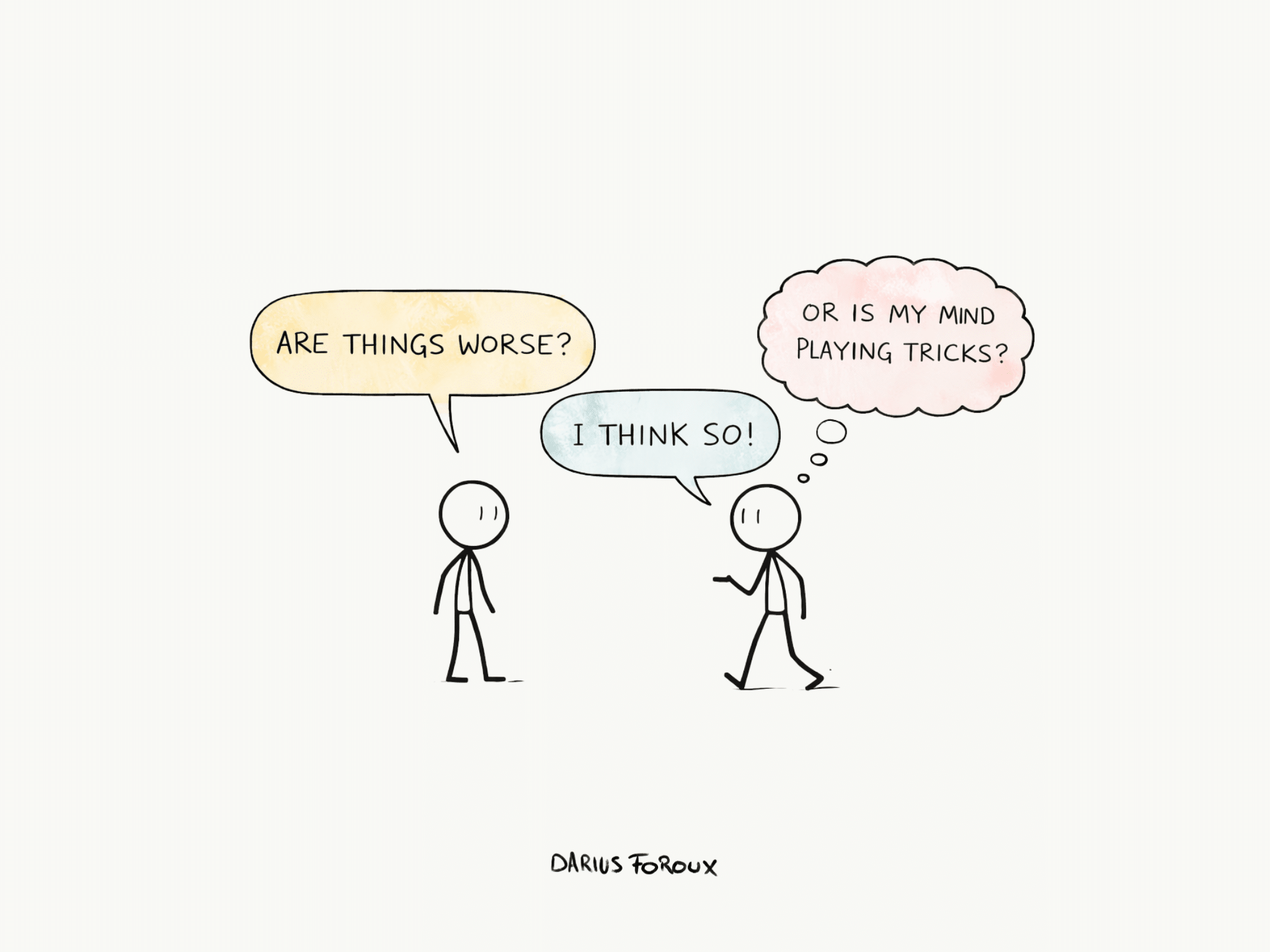
Over the past year, I feel like I’ve had this conversation almost every week.
The world is going crazy. Artificial intelligence will replace everyone’s job. People don’t want to work anymore. Everything is expensive. Politicians are evil.
All in the same conversation. The conclusion is always the same: life was better ten years ago.
Maybe yes. Maybe not.
But this is what I know for sure. Spending your energy on this problem is one of the most expensive things you can do.
That’s what this article is about.
Not whether life actually gets worse.
But why do we think so, and what should we do about it?
Your brain is lying to you
Before you accept that everything is getting worse, consider the following. The human mind is not a reliable narrator of history.
Cognitive biases are systematic errors in thinking. A mental shortcut that distorts our view of reality. We all have them. They are not a sign of weakness or stupidity. This is how the brain works. The problem is, some of them are particularly good at making the moment feel bleak.
Three of them are worth knowing.
The first one is Rose colored review. This is the tendency to remember the past better than it actually was. Research into this goes back decades.
We always evaluate past experiences more positively in our memory than when they actually occurred. Your brain will eliminate boredom, anxiety, and uncertainty. The rest is just a highlight reel that you never really lived.
The second one is Declinism. This is the belief that society is in decline and that things are getting worse. Historians and psychologists have documented this for centuries.
Each generation believes that the previous generation was better. The Romans feared that society was collapsing. Medieval scholars mourned the loss of ancient wisdom. But here we are now. Decline theory feels real because its evidence is always available. If you look closely enough, you can always see things getting worse.
The third one is Negativity bias. Bad news grabs our attention more than good news. Always. Our brains evolved to notice threats. A tiger in the grass deserves more attention than a pleasant sunset.
The wiring has not changed. But the media caught on to this early on and have been reporting on it ever since. The world you see through News Feed is not a representative sample of reality. It’s the worst, carefully curated and delivered directly to your nervous system.
Put these three together and you’ve got a solid machine that can make the moment feel worse than it actually is. It’s not because life is bad. Because your brain is doing what brains do.
As the psychologist Daniel Kahneman observed, we are not sentient thinking machines.
We are thinking feeling machines.
Emotional color memory. Memories color what we see today.
To be honest, I’m not sure if life would be better
This is where I want to be honest with you.
Until recently, some people felt confident that life was objectively getting better every year. Crime rates are falling. Cars are becoming safer and safer. More disposable income. Global poverty is declining. etc.
I find it difficult to make this argument with the same confidence today.
There is a clear story from the past few decades. Since the 1980s, each decade has brought significant progress.
Technology has gotten better. Opportunities have expanded. Life becomes more comfortable and more connected. Every decade, something real changes happen.
How has your daily life changed over the past decade? You have a smartphone. A big TV. Energy efficient cars. Netflix. Online shopping. These things also existed in 2015.
The basics of daily life remain largely the same, but the cost of living rises, and so does anxiety about the future.
So I’m not here to tell you everything is fine. I’m just saying that whether something is good or bad is not the right question.
What really determines how you see the world
One thing I’ve come to believe is that your worldview is largely determined by when you enter the workforce.
I completed my master’s degree at the end of 2010, when the global economy was in the midst of a severe recession. Negativity is everywhere. Job opportunities are scarce.
I remember what it felt like to complete years of education only to find that I had nowhere to go. This shaped my view of economic risk to this day.
People who entered the workforce around 2015 or 2016 have a completely different perspective. Full growth model. Opportunities are everywhere. It’s easy to be optimistic.
Neither view is objective. Both are true.
Now, many graduates are facing something similar to our generation, but with a new twist.
The careers they spent years training for were disrupted by artificial intelligence before they even started. This dream was shattered between the first and last year of their degree. It’s really hard.
But that’s the nature of life. It rarely goes as planned. The world doesn’t stand still when you’re ready.
This is where Stoicism has helped me more than anything I have ever learned.
The Stoics did not live in easy times either. Marcus Aurelius ruled during a period of plague, war, and ongoing political instability. Seneca experienced corruption, exile, and was finally forced to take his own life. Epictetus was born a slave.
Yet their message is consistent: focus on what you can control. It’s not about the environment, it’s about how you react to the environment.
Marcus Aurelius wrote in his private diary:
“You have the power over your thoughts, not external events. Realize this and you will find power.”
Epictetus puts it more bluntly:
“Use your power to its full potential and let the rest take its course.”
These are not motivational posters. They are a survival tool in really hard times. That’s why they’re still working.
Dwelling on the past is a waste of energy
For the sake of argument, let’s assume that life did get better in 2015. The world has indeed become harder and more uncertain.
How does this idea improve your life today?
This is not the case. Can’t. The past is fixed. You can study it, learn from it, and use it as background. But you can’t live in it.
When you spend your energy lamenting a world that no longer exists, you deplete the resources you need to navigate a world that no longer exists.
I’ve had this conversation too. Someone spends an hour talking about all the things that are wrong in the world, only to leave the conversation feeling worse than it started. I understand the impulse.
But at some point, you have to ask: What’s in it for me?
The Stoics called this the discipline of desire.
Wanting things to be different than they actually are is a source of the most unnecessary suffering. Not the environment itself, but the resistance to the environment.
Seneca wrote more than two thousand years ago:
“It’s not that we don’t dare because things are difficult. It’s that things are difficult because we don’t dare.”
This is not an instruction to be passive. Stoics were not passive people. It’s a directive to put your energy where it really makes a difference.
Stop fighting reality and start working with it. I think back to this question every time I find myself in one of the following conversations:
Is it worth my time to highlight the current state of the world?
Most of the time, the answer is no.
Not because the world doesn’t matter. But because your energy is more important. The best thing you can do with it is build something, help others, or improve yourself.
This is what you can control. Everything else is noise.