Have you ever looked at your to-do list and felt overwhelmed by all the things that need your attention? When every task seems important, it can be hard to know where to start. As a result, you may end up jumping between various responsibilities, feeling busy throughout the day without making meaningful progress.
The challenge is that not all tasks are worthy of the same investment of time and effort. Some require immediate action, while others will help your long-term goals. Without a clear priority system, it’s easy to focus on urgent distractions and lose sight of what’s truly important.
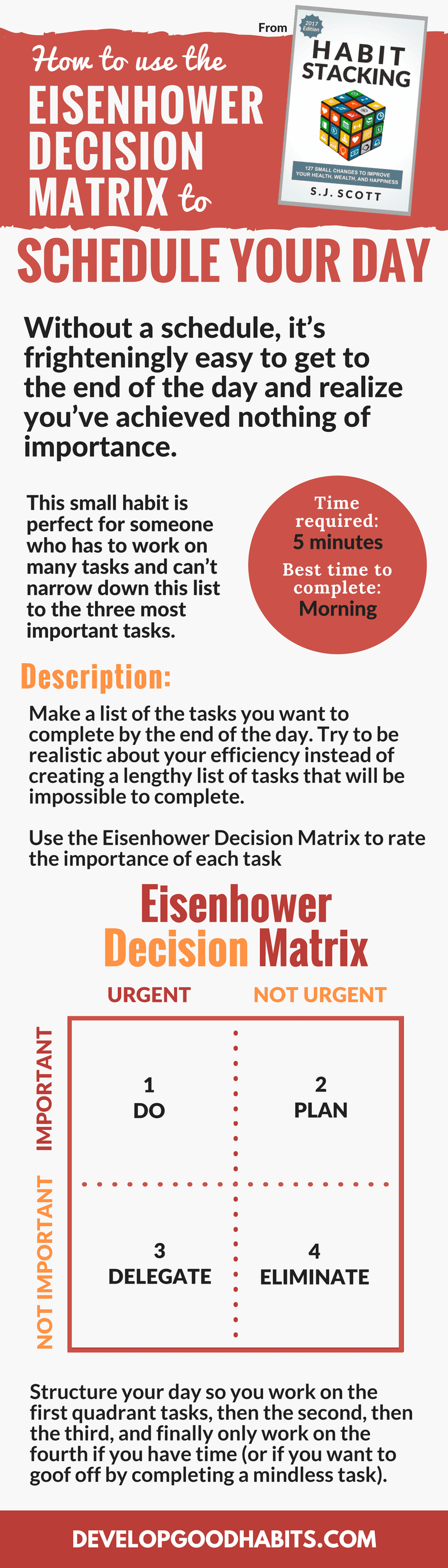
This is where the Eisenhower Matrix can help. This simple yet powerful decision-making tool helps you sort tasks according to their urgency and importance, making it easier to determine what to do first, what to schedule for later, what to delegate, and what to eliminate entirely.
By organizing your priorities more effectively, you can reduce stress, be more productive, and spend more time doing the activities that have the greatest impact on your work and personal life.
In this article, you’ll learn how the Eisenhower Matrix works and how you can use it to make smarter decisions about your time and energy. Also, be sure to grab the free Priority Matrix at the end of the article to help you put this powerful productivity method into practice.
How President Eisenhower used this matrix

Before becoming the 34th President of the United States, Dwight Eisenhower He served as an Army general and as Supreme Commander of the Allied Forces during World War II. While serving in the Army, Eisenhower faced many difficult decisions regarding the missions he had to focus on every day. This led him to invent a principle that helps us prioritize tasks based on urgency and importance.
Using the Eisenhower Matrix
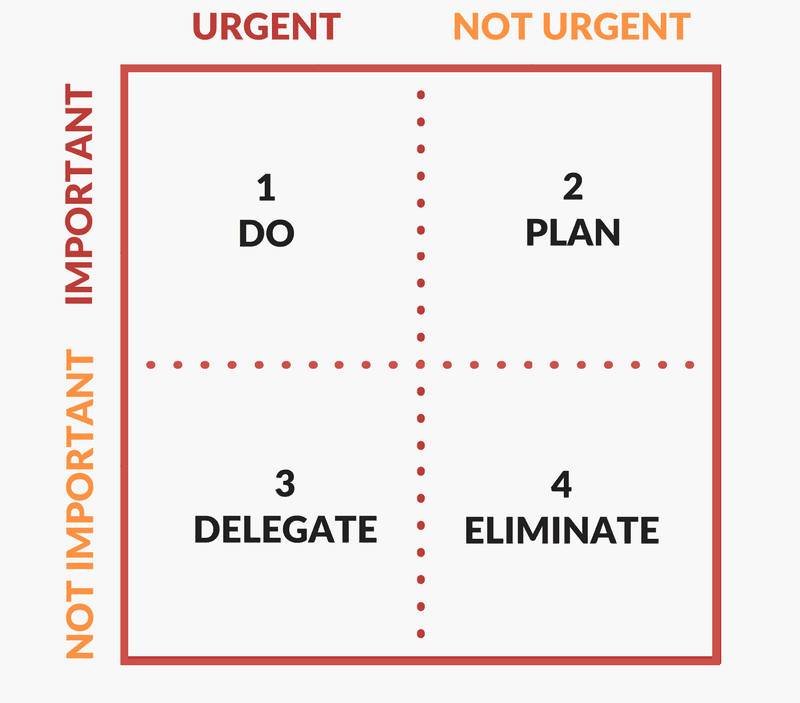
This Eisenhower matrix produces four quadrants with different strategies. Stephen Covey, author Seven Habits of Highly Effective Peoplefurther popularized Eisenhower’s concept of this time management matrix by supporting Eisenhower’s use of the four quadrants to determine the urgency of one’s tasks.
Here’s how the four quadrants work:
Quadrant 1: Do it first
Quadrant 1 contains tasks that are both urgent and important. These are “first things first” tasks because they are critical to your life or career in some way and need to be completed immediately. You want to complete these tasks as quickly as possible.
These are tasks that need to be completed to avoid negative consequences. It is important to be able to manage the tasks in Quadrant 1.
An example of a Quadrant 1 task in your career might be responding to time-sensitive emails from clients. This matrix can also be used in your personal life. An example of a Quadrant 1 task in your personal life might be a crying baby, a medical emergency, or something burning in the oven.
Quadrant 2: Decide When
Quadrant 2 tasks are important, but not urgent. This is where you want to invest most of your time. Quadrant II tasks align with your long-term goals.
What are some examples of these tasks? Well, exercise is important for your health, but you decide when to do it. Spending time with family is also important, but again, this can be aligned with your schedule. When it comes to your career, you may benefit from getting another degree or some kind of certification. These things are important to your career but don’t need to be done right away.
It’s important to remember that everyone has different goals and objectives, so just because something falls into Quadrant 2 for you, it may not be the right fit for the next person. Additionally, just because these tasks aren’t urgent doesn’t mean they aren’t important. People often associate urgent matters with important matters, but this is not always the case. Because your goals will remain the same, anything that benefits you long-term will fall into Quadrant Two.
Quadrant 3: Delegation
Have you ever felt like you took a task too seriously that in hindsight didn’t seem important? Or think you have to do something right away, but actually don’t?
If so, then your relationship is great.
This common mistake usually occurs when someone asks you to do something that won’t directly benefit you or bring you closer to achieving your goals. For Quadrant 3 tasks, it’s important to learn and remember how to delegate certain things.
When you think something is urgent but actually isn’t, it’s usually an external source of distraction. This might include constantly checking your email or phone, or responding immediately when people try to contact you. You may think it’s urgent, so you stop what you’re doing to deal with it. But actually, it can wait.
If you’re working on a project and the phone rings, it doesn’t matter to you to answer it. Therefore, you can delegate this task to others. Things may seem urgent when they happen, but these little things can be handled by others.
Quadrant 4: Delete it
Honestly, you want to avoid quadrant four tasks. These tasks are just a waste of your time and should be eliminated. If you can identify and eliminate all Quadrant 4 tasks, you will free up some much-needed time to invest in Quadrant 2 tasks.
Some examples of Quadrant 4 tasks include playing video games, watching a TV show you’ve already watched, or mindless web browsing.
Does this mean that nothing in Quadrant Four should be a part of your life? Won’t. It’s important to maintain a balance between your professional and personal lives, and downtime can help you recharge. The challenge here is to spend most of your time in Quadrant 2 and enough time in Quadrant 4 to get by.
Procrastination and the Eisenhower Matrix
Sometimes it’s easy to confuse the differences between tasks. Maybe you have a must-do list that seems equally urgent and important, but you can’t seem to get it all done. Part of procrastination is Figure out why you procrastinate. If you don’t do this and fix the problem, you may be spending a lot of time on Quadrant 3 and Quadrant 4 tasks that aren’t important.
Quadrant II tasks are easy to procrastinate because, although they are important, they do not need to be completed immediately. If you have something more urgent, like a phone call or even just doing a favor for a co-worker, these may take priority in your mind, but end up being just another form of procrastination.
How to use the Eisenhower Matrix to see if you procrastinate
To find out whether you spend most of your time in the first two quadrants, take a week-long assessment. To do this, make six blank grids, use one grid each day, and list the tasks or activities you did and how much time you spent on each. When all grids are full, combine Monday through Friday into a sixth total grid and calculate the time you spent in each grid, then break those numbers down into percentages. Evaluate how efficiently you are spending your time and whether your processes need to be reorganized.
(To learn about other decision matrices, Check out these free decision matrix templates! )
brain dump
Why is this important?
We live in a time-pressured world, and you may have multiple overlapping commitments that feel like they need to be completed immediately. This means that real urgency is not limited to special situations, as emergencies seem to happen every day.
You won’t succeed in your career if you constantly miss deadlines or let truly urgent matters sit on your desk. Instead, you must learn how to manage the responsibilities you are constantly taking on while still doing your job well. The Eisenhower Matrix is an effective method Organize your priorities.
As mentioned before, this can also affect your personal life. For example, you might receive a personal call at work that seems urgent but isn’t actually very important. In order for this strategy to be effective, it needs to be classified into the appropriate quadrant.
If you see something urgent and important that will have a big impact on your future, set aside a full half-day to focus on it. Get rid of any possible distractions, turn off email and phone calls, close the door, or even take projects to a remote office area where no one can distract you. Complete tasks so you can cross them off your list.
It’s easy to spend most of your time in quadrants 1 and 3 and very little time in quadrant 2. Quadrant 3 is popular because it makes you look and feel busy. However, in order to remain efficient and effective in the long term, Quadrant 2 should be your primary focus.
You can also look at the matrix this way: You spend most of your life living in the upper part of the matrix. Work in Quadrant 1, then spend the rest of your time in Quadrant 2. Use quadrants 3 and 4 only when necessary.
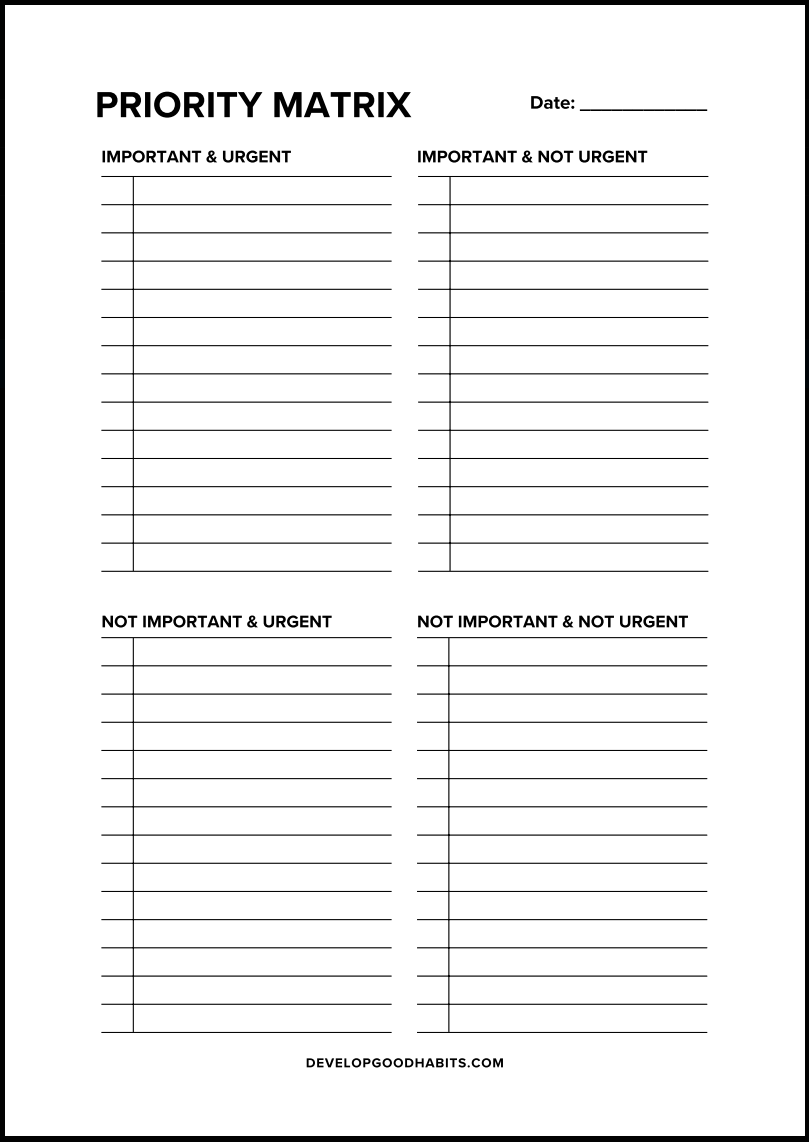
Free Download: Priority Matrix
This priority matrix helps you quickly organize your tasks according to urgency and importance, making it easier to focus on what really matters. It’s a practical tool to reduce stress, increase productivity, and make smarter decisions about how to spend your time.
Download the matrix and start prioritizing tasks with more clarity and confidence.
(This link will open a Google Drive folder where you can download the PDF in various sizes: A4, A5, and US Letter.)
Eisenhower.me
So this sounds like a good idea in theory, but where do you start? Eisenhower.me is a website created with simplicity in mind and designed to make the entire process easy for you. They can let you know where your tasks fit into the quadrant grid through apps and strategies. This will help you focus on your most important tasks. Eisenhower.me helps you easily schedule and plan your day while minimizing stress and increasing productivity.
You might think this tool sounds outdated because of its association with Dwight Eisenhower. It’s an old idea, but it’s widely accepted and has been used successfully for decades.
Following the guidelines provided on Eisenhower.me will save you time and benefit you greatly. Time cannot be bought and is often mismanaged. This tool gives you the opportunity to think about the time you are mindlessly wasting every day.
When you apply these practices to your professional and personal life, you’ll be able to plan ahead, be more efficient, and become more effective. You want to be able to manage your work with the time you have available to avoid procrastination, which will help reduce stress. Improper time management can easily lead to stress and burnout.
Learning the principles of planning, prioritization, delegation, and scheduling will help you find the right things to do to achieve success. Here is a simple matrix to help you achieve your goals and succeed in life.
==>>View the Eisenhower.me website
Finally, if you want to improve your productivity and time management skills, Then watch this free video to learn 9 productive habits you can adopt at work.
Number