Most people view mind wandering as a flaw. They see this as a hole in their productivity.
- “It’s time to get back to work.”
- “Stop daydreaming.”
We’ve been conditioned to believe that if we’re not staring at a screen or checking off our to-do list, we’re failing.
But psychologist Daniel Goleman, who popularized emotional intelligence, argued the opposite in his book focus:
“Mind wandering is the source of creativity…The problem is not that our minds wander, but that they distract from what is important.”
This quote is important because it exposes a modern lie: You can’t be “on” all the time.
But when you try to stay “on” 24/7, you don’t actually get more work done.
You’ll just become mentally exhausted, less creative and, ironically, unable to focus when it really matters.
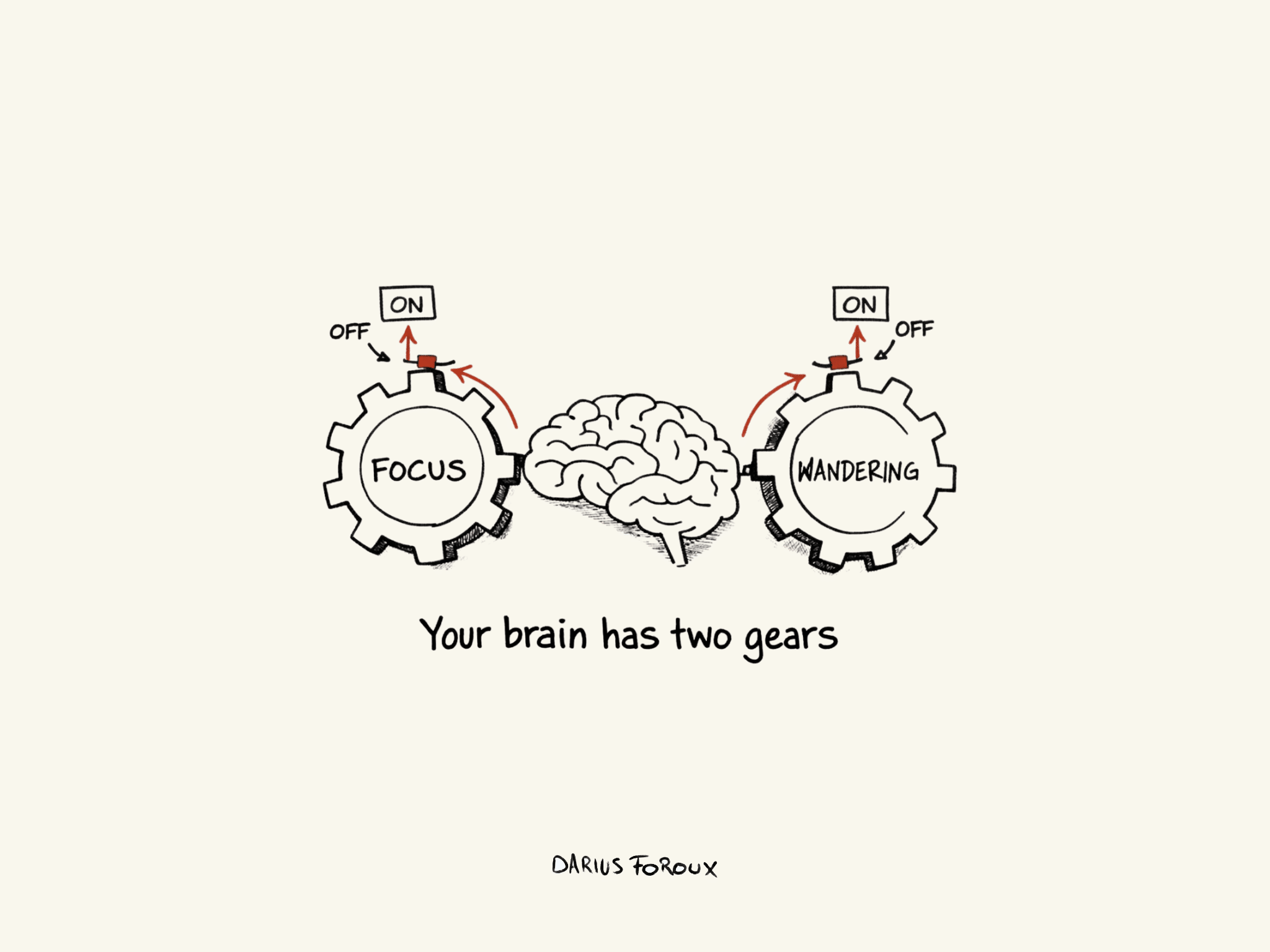
Your brain has two gears
Neuroscience tells us that the brain operates in two main modes.
- Task Positive Network (TPN): This is your “focus” equipment. It’s active when you’re solving a math problem or writing a report.
- Default Mode Network (DMN): This is your “wandering” gear. It comes into play when you rest, daydream, or reflect on the future.
The DMN is where the magic happens. It’s responsible for “autobiographical planning” – understanding your life and connecting disparate ideas.
“Rest” is not a waste of time. This is integration.
This is the process by which your brain stitches together the information you feed it. If you don’t allow this stitching to happen, you get a common modern result: you’re busy all day long, but nothing “clicks.”
There is a famous Harvard research Titled “A wandering mind is an unhappy mind.” Research has found that when people are distracted, they often feel less happy.
Most people use this as an excuse to kill their daydreams. But that’s like saying exercise is bad because your muscles will get sore.
The problem is not wandering per se; it is Uncontrolled wandering.
It feels bad to have an anxious mind wandering in a cycle of “what ifs.”
But a rested mind roaming freely produces insights. It’s the same behavior but using different fuel.
One is stimulated by pressure; the other is stimulated by pressure. The other is fueled by curiosity.
Marcus Aurelius described this nearly 2,000 years ago:
“Nowhere can one find a quieter, more carefree retreat than within one’s own soul.”
But Seneca added an important caveat. He said: “Idle time without learning is death and the grave of the living.”
The secret is Wandering on purpose.
Don’t let your mind sink into the abyss of anxiety. Give it space to explore important ideas.
Post-pandemic overcorrection
Why are so many of us always restless? Why do we get nervous when we hang out for a while?
I believe COVID-19 has played a huge role in the development of our brains over the past few years.
2020 and 2021 are very long. Our view of the past six years is distorted.
Yes, it’s been six years!
Most countries were locked down for two years. Then it will slowly recover from 2022, and then it will be almost normal by 2023. But because we’re forced to wander around with nothing to do, we don’t want to do that anymore
I think most of us are stuck in this permanent state of being “on” because we still feel the pain of being turned off.
When the restrictions are gone, we want to do as much as possible
Our brains change as a result.
We cannot slow down as it reminds us of the fears of 2020 and 2021.
It’s almost like post-traumatic stress disorder (PTSD)
I still hear people talking about COVID like it was yesterday. It’s as if they’re still scrambling to make the most of their time before heading into the next lockdown.
To this day, people are constantly trying to Eliminate boredom.
But when we eliminate boredom, we also eliminate wandering minds.
When we stifle wandering thoughts, we stifle our ability to innovate.
How to restore a more natural rhythm so you can become more productive again
You can’t stay focused 24/7, just like you can’t hold a plank 24/7. Attention is a limited resource.
In psychology, Attention Restoration Theory (ART) Shows that our “directed attention” (TPN) becomes fatigued.
To solve this problem, we need “soft charm,” nature-like environments that easily capture our attention.
If you want to focus better, you need more unfocused time. Not “cheap entertainment” (social media), but real “down” time.
The goal is not to become a monk. The goal is to train the “switch.” You want it to be 100% “on” when working and 100% “off” when charging.
Here’s how to train this skill:
- Recycle a “dead zone” every day: Pick an activity – classic examples of walking to your car, waiting for your coffee, or doing the dishes. Do this with zero input. No phone. No music. Let your thoughts drift.
- “The Blank Road”: Three times a week, walk for 20 minutes without sound. It will feel uncomfortable for the first five minutes. This is the “itch” of digital addiction leaving the body.
- Set “input cutoff”: Choose a time when you stop consuming new information (for example, 8:00 p.m.). No news, no podcasts, no “learning.” Your brain needs time to digest what you learned during the day.
- Keep “wandering log”: Keep a small notebook or notes on your phone. When a good idea comes to you during your “down” time, write it down immediately before you continue to wander around.
Today, the ultimate status symbol is being busy. We believe that being available and informed 24/7 makes us valuable.
In fact, it just makes us miserable.
Wandering is not the enemy of concentration. This is its basis. If you want to produce better work, you don’t need to be busier. You need more space.
Your brain doesn’t operate at high intensity. It runs rhythmically.