
“I do push-ups and sit-ups every day. I never stop.”
— Herschel Walker
Herschel Walker didn’t have a grueling two-hour workout to complete thousands of push-ups.
He does it like water carving rock.
A little at a time, all day, decades.
This detail is important.
Because the method behind Walker’s legendary weight and volume is far simpler than most people think.
This simplicity is why it works.
The actual situation is this.
focus
-
Walker didn’t practice — he practiced all day.
He aims to complete one per day and do group training during his waking hours. -
Low fatigue makes high training volumes possible.
Most sets were far from failure, which kept him repeating again and again. -
Consistency is more important than intensity.
There is no loop. No rest. Decades of persistence triumph over fleeting moments of motivation. -
Change saved him from burnout.
He constantly changes the style, rhythm and difficulty of push-ups, so there is no one movement that can stop him. -
Assignment changes the stimulus.
There’s a fundamental difference between doing 1,500 push-ups in one day and doing 1,500 push-ups in one sitting. -
The real secret is patience.
The thousands of representatives were not forced—they were built up gradually over the years.
Overview summary
Herschel Walker’s thousands of push-ups a day weren’t the result of brutal exercise or superhuman perseverance.
They come from a deceptively simple system: daily goals, divided into small groups, distributed throughout the day, and repeated over decades.
Walker didn’t train to exhaustion; About Fatigue – Keep each set easy enough for quick recovery, rotate variations to manage stress, and allow volume to build up naturally over time.
This article breaks down the structure behind this system—how he distributes the work, why low fatigue is more important than intensity, and why consistency over the years has reshaped his body in ways that short-term plans cannot.
The lesson is not to copy his numbers.
It’s about understanding the architecture that makes them possible—and why simplicity, patience, and decentralization quietly trump drudgery.
Daily goals—not workouts
Walker did not consider exercise.
He thinks that from one perspective Number of days.
Depending on the stage of his career, that goal ranges roughly from 1,500 to 3,500 push-ups per day — lower during his MMA career and higher during pure bodyweight training.
Main differences:
He never tried to complete them in one session.
Instead, he repeats in small, frequent sets throughout the waking day—often just 10 to 20 times at a timetake a short break.
Think less about “exercise.”
think practice.
-
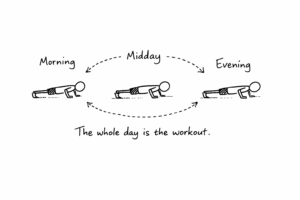
morning group
-
Another neighborhood around noon
-
One more time in the evening
-
Plus scattered collections fill the gaps between
all day Was training courses.
Any moment is easy.
The cumulative amount is huge.
A rough illustration of 1,500 repetitions a day (not his exact number, but the same architecture):
That’s 900 times.
Do a few more sets throughout the day and you can quietly bring home the whole thing.
Inside the Push-up Block: Rotate, Not Repeat
This is not mindless repetition.
In these miniature scenes, Walker takes turns Difficulty, pace and variety Manage fatigue and keep stimulation fresh.
According to reports, a typical push-up block looks like this:
-
partial range push-ups (drop midway) for higher reps – build volume without premature burnout
-
more difficult changes (Single arm, diamond, narrow grip) Repeat 10-20 times
-
Slow standard push-ups Emphasis on stressful times
-
Stand on the ground and stand upusually in groups of about 10 people, with short rest periods
Patterns are important:
Easier high reps → Harder variations → Easier again → Slow reps → Overhead press.
Then repeat.
None of the changes accumulated enough fatigue to make him stop.
But overall trading volume continues to rise.
Complete daily pictures
Push-ups are just one of the pillars.
Walker’s entire training revolves around extreme volume aerobicsEvery day for decades – without traditional weights.
His daily structure also includes:
-
Sit-ups: 2,000–3,000 per day, building incrementally from groups of 10 using the same micro-set method
-
Other bodyweight exercises: High-rep dips, squats, lunges, pull-ups and jumps
-
Conditioning: Sprint and rope work to stay explosive
No barbells.
There are no machines.
No gym membership.
Just his body, gravity, and an almost incomprehensible commitment to showing up every day.
Why it works (and what most people miss)
Looking at those numbers, it would be easy to think that Walker is just a genetic outlier—and his genes certainly help.
but method There is much more explained than the original total.
His sales were accumulated over years, not weeks.
Walker said that as a child he could barely do 10 push-ups and 10 sit-ups.
Not a single project jumped from 50 to 2,000.
It’s just a small amount, and the patient will compound the interest over a long period of time.
The lower fatigue level of each group is the engine.
Each set was far from failure—he only did 20 of the 80 he could do.
This meant he never developed deep fatigue that required long periods of recovery.
Simple setup can be repeated throughout the day.
This is the same principle that became popular later Oil the grooves.
Consistency in beat intensity.
Walker didn’t ride the bike on and off.
He has not reached his peak, nor has he lost weight.
He never stopped at all.
Decades of daily training build layers of connective tissue, work capacity, and endurance—adaptations that a 12-week program simply cannot achieve.
Distribution is as important as total quantity.
Doing 1,500 push-ups in 16 waking hours is a completely different stimulus than doing 1,500 push-ups in 90 minutes.
Spreading the effort out keeps each game moderate, allowing for true recovery and allowing the body to absorb work that would otherwise be overwhelming if compressed.
takeout
You don’t need to do 3,000 push-ups every day.
But the underlying architecture is available to anyone:
-
Daily goals instead of scheduled workouts
-
Small packages keep failure away
-
Control changes in fatigue
-
Consistency measured in years
Walker’s real secret isn’t superhuman willpower or weird genes – even though he has both.
It’s such a simple system, the only hard part is never giving up.
He never gave up.
get this book

If you want to get this philosophy straight from the source, Herschel Walker’s Basic Training Herschel Walker illustrates this point in his own words.
This book is not a modern training program or a step-by-step exercise program.
Here’s a window into the mindset and daily discipline behind his legendary bodyweight training.
Walker explains:
-
why he trains every daynot in the loop
-
How small group training consistently beats brutal training
-
How decades of patience and accumulation shaped his strength
If you’re curious about how someone actually Lived This approach–not just push-ups, but the mindset behind it–fills a gap that this article can only outline.
get Herschel Walker’s Basic Training on amazon
(Available in paperback and second-hand versions)
You may also like
25 Best Exercises to Master Calisthenics