Hello everyone! Today I want to share a concept that is very suitable for personal growth: law of diminishing returns. It teaches us how to maximize the output of our time and energy and get the most out of life.
I learned this when I was studying economics in school and it said this:
The law of diminishing returns states that as more units of variable inputs (such as time, energy) are added to the production process, The additional output (or benefit) of each new unit eventually decreases.(1)

(image)
Suppose you have a corn field and you want to increase corn yields by fertilizing it.
- Adding a bag of fertilizer can significantly increase crop yields.
- Adding a second and third bag further increases yield by about the same amount.
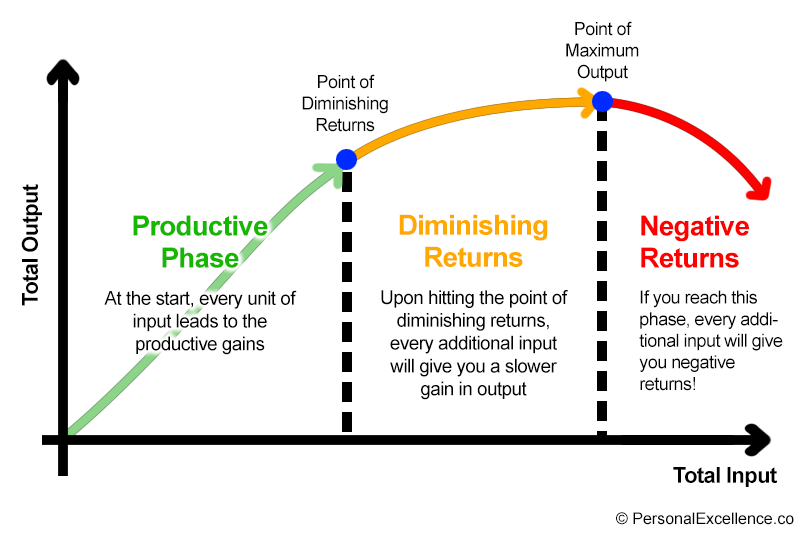
- Adding a fourth bag still increases it, but by a smaller amount. Each additional bag after that contributes less and less to the total yield, even with the exact same type of fertilizer! This smaller increase in output is called diminishing returns.
- If you keep adding more fertilizer without diminishing returns, the field will be over-fertilized and you will get a reduce Total corn production! this is what is called negative return.
See picture below:
(image: personal excellence)
Diminishing returns in our lives
In fact, diminishing returns can be observed in different areas of our lives. Consider these examples:
- Work. The first few hours of the workday are often the most productive. Later in life, as our energy dwindles, productivity begins to decline. At some point, it leads to burnout.
- Social media. While using social media can be fun and enjoyable at first, it becomes less enjoyable after a while. Using it for 2, 3, 4 hours can make people feel exhausted and reduce our productivity.
- study. When we learn the basic concepts of a topic, the first book we read is often the most helpful. Reading 10 more books on the same topic may continue to help. But what about reading 20, 30 or 50 books about the same thing? It becomes repetitive and provides diminishing returns (Unless the book is extremely well written and adds unique value to the topic).
- Meeting. have weekly meetings Improves clarity and collaboration in your work. But too many meetings add little value, take away from productive work time, and cause mental drain.
As a writer, I usually produce higher results within the first 2-3 hours of writing. Past a certain point I was editing and rewriting key points without much gain. That’s my diminishing returns point.
For my website content, it helps my readers when I write about new topics. But to write 10, 20, 30 articles on the same topic without any new insights or ideas? It leads to diminishing returns, which is why I don’t write duplicate content, although it’s common for self-help blogs to do so.
Can you see diminishing returns in life?
What can we learn from this 💡
The law of diminishing returns tells us something important:
- first, More is not always better. Beyond a certain point, adding more time, effort, or resources causes output growth to slow. In addition to this, it can lead to negative returns.
- second, It’s important to find the sweet spot that gives you the best return. By strategically allocating our time, energy, and resources, we can achieve greater results without increasing our investment.
- third, rest and change It can help us maintain high levels of production output over the long term.
This is true whether it’s in work, relationships, health, or upskilling. For example, with relationships, there are diminishing returns to having too much Meeting once a week – this takes away from my productive hours and my time. When it comes to health, there are diminishing returns with every health regimen you follow – it’s best to branch out and try other methods that will lead to rapid progress.
At its core, the law of diminishing returns reminds us to work smarter and achieve better results with less wasted effort.
For every goal you’re working towards (whether it’s work, health, sports, relationships, etc.), you want to focus on the steps that will give you the greatest reward, and stop and change your actions when you reach diminishing returns.

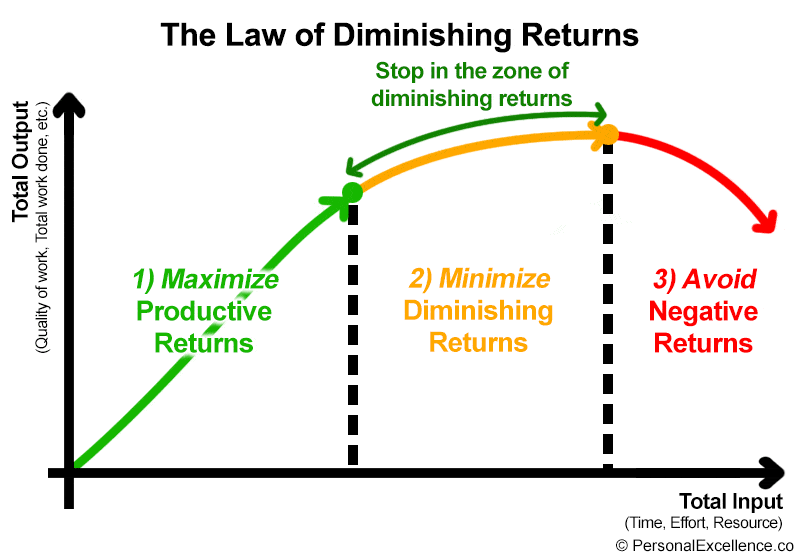
When the increased investment cannot justify the return, it stops in the area of diminishing returns (Figure: personal excellence)
For example:
- Studying: Studying for 2 hours can help you learn a lot, but studying for 6 hours straight may lead to memory loss and smaller gains per hour. Take a short break to move around, rest, recharge, and come back with better focus.
- Creative content: When building a report, you’ll spend 2 hours creating a solid draft and another hour refining it. Yet by the fourth hour, you’re busy nitpicking details that have no real impact on the output. That means it’s time to wrap things up and move on.
- Improve health: Let’s say you’re optimizing your health. You’ve tried multiple supplements, but they either have little or no significant effect. Here, branch out and try new things. Try saunas, castor oil, grounding, switching to a whole foods diet, herbs, and exercise. Research supplements that target different areas of health. Join the wellness community and get new ideas to drive your progress.
- Growing blog: Finally, you’ve been guest posting, which has given you some serious traffic growth. However, these days it’s hard to find sites where you can guest post, and the traffic gains from this strategy have diminished. At this point, it’s best to turn to other strategies, such as Tiktok, YouTube, or Pinterest.
Managing the Law of Diminishing Returns: How to Maximize Productivity and Benefits📈
So how can you maximize productive gains and minimize Spending the same time and effort with diminishing returns? Very importantly, how to avoid negative returns? Here are my 7 suggestions.
- Recognize when your rate of return is diminishing.
- Be careful when you enter the zone of diminishing returns. Telltale signs are when your progress is slow, you get less bang for your buck, the quality of your tasks doesn’t improve significantly, or you feel mentally fatigued.
- For quantifiable goals (e.g., increase subscribers, sales), track and measure to understand when diminishing returns begin.
- Work within strategic hours.
- Identify your most productive times of day and design your workday around those times. Try to spend these productive hours on your most important tasks.
- focus on 80/20.
- Focus on high-impact strategies. For each goal, adopt the strategy that will give you the best return. When progress slows, adjust your approach and adopt the next best strategy.
- Prioritize high-impact tasks. Each day, focus on the tasks that will have the greatest impact on your end goal. Ask yourself, “Is this the best use of my time? Is this the most meaningful thing I can do right now?”
- Avoid fine-tuning that leads to forgetting. When completing a task, you may fine-tune things until you forget about them. Perfectionism is a good thing, but save it for the tasks that really matter. As with most tasks, complete them with good enough quality and move on. read: How to overcome perfectionism (series)
- Give yourself a break. Know that you work most efficiently when you have energy, not just when you’re sitting at your desk. Rest and rejuvenation are essential to regaining productivity.
- Take steps to restore cognition before returning to higher-order tasks. If you can, change the environment. Try taking appropriate breaks such as walking, practicing self-care, watching videos you likeor spending time with loved ones.
- Take a few days off and do something different from usual (e.g. weekend trip, short trip) to rejuvenate your mind and spirit.
- Switch it up. Switch between tasks to keep engagement high. For example:
- Work: Switch between high-level tasks when you’re energetic and low-level tasks (email, admin) when you’re tired.
- Write a book: Switch between writing chapters, designing a book cover, and developing a marketing plan.
- Know when to stop or change actions. When entering a state of diminishing returns, monitor your progress and decide when to stop or pivot. Ask yourself, “Am I still getting good results, or are there diminishing returns?” If the extra effort brings minimal benefit, and the payoff isn’t worth it, it might be time to take a break, move on to the next task, or change your approach.
- Get feedback whenever possible. Always involve others in what you’re doing to avoid getting tunnel vision. If you work in a company, involve your colleagues and managers to get their feedback. If you’re an independent creator, you can talk to friends and family, or share your ideas with industry peers and forums. This prevents wasting energy on things that are not feasible.
last word
Finally, regularly think about your goals in the context of other goals and priorities. Even if a goal brings you productive benefits now, it may lead to diminishing returns in other areas of your life, so your goal may not be to maximize those good benefits.
For example, maybe you have good financial benefits and opportunities at work, but it leads to diminishing returns in your fulfillment and personal life (e.g., health, family). Here, you may decide to turn your attention to your personal life and spend less time at work, even though you are making progress at work.
For example: Patrick Dempsey is the leading actor in this film and the highest-paid actor. Grey’s Anatomy In April 2015, he abruptly left the role. The show was doing very well at the time and was in its 11th season. So why did he leave? Although Dempsey’s career was progressing tremendously and he was making a lot of money, he was exhausted by a 15-hour-a-day shooting schedule for 10 months. “I think after a while, no matter how much money you make, you want to be able to control your schedule,” he said in an interview.(2)
His marriage was also a driving factor, as his wife filed for divorce a few months ago in January 2015. “I’m not ready to give up on our marriage,” he said. It was a “scary” feeling to know their marriage might be ending. Through couples counseling, they reconciled and called off their divorce in 2016.(3)
Know that there is a larger context, which is your ultimate goal and other priorities in your life. Your priorities are always changing based on what’s going on in your life. You must evaluate whether you are still getting meaningful gains from what you are doing (e.g., money, happiness, fulfillment), or whether there is more value in turning your attention to other things (e.g., health, relationships, or family).
To you
Next time you are engaged in a task or activity, ask yourself:
- Am I getting great returns, or are there diminishing returns?
- Is the return on the additional investment reasonable?
- If the rewards aren’t worth it, it may be time to stop the task or activity. Take a break and move on to the next task, or change your approach.
Learn to recognize diminishing returns in life and direct your efforts accordingly to areas where you will receive the greatest returns. This way, you can get more out of life with the same time, energy, and resources. 🙂
Related posts: